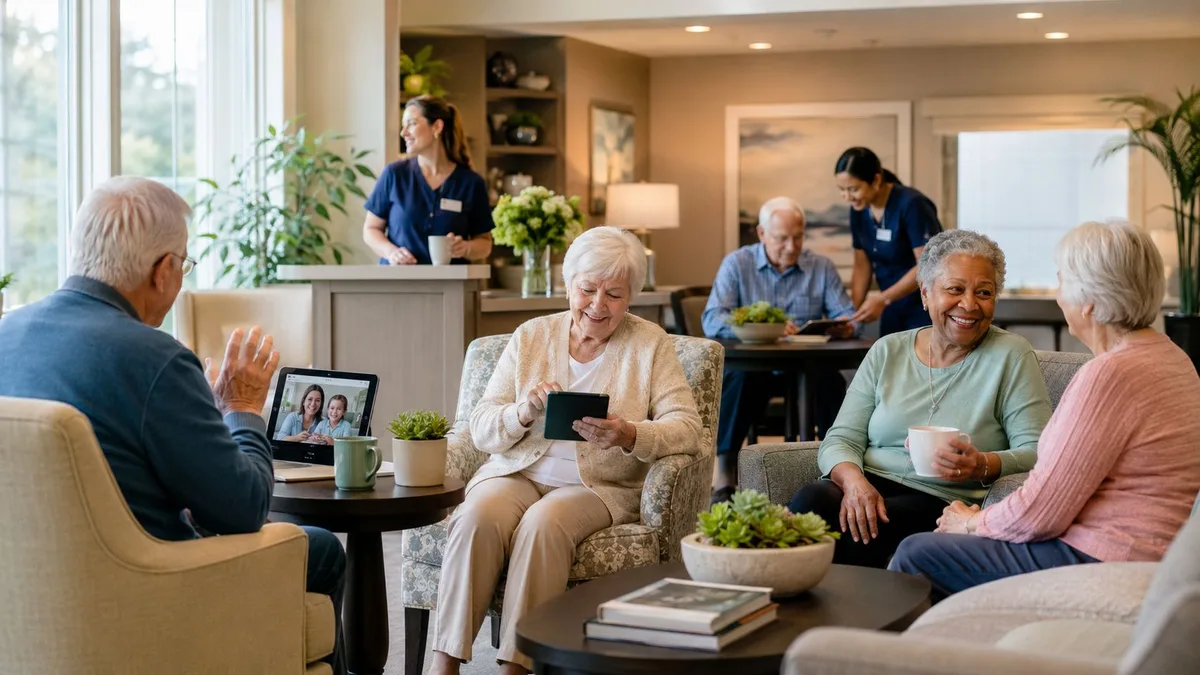
Home Care Technology That Keeps Clients, Families, and Care Teams Connected

Home care takes place inside a person’s daily life. The care environment includes the client, paid caregivers, family members, the home itself, and the routines that help the person remain safe and independent. Technology has to work within that environment.
For home care leaders, the technology question extends beyond scheduling and electronic visit verification. Agencies also need practical ways to communicate with clients, keep authorized family members informed, distribute education, support social connection, and connect people with additional services. These needs become more complex when an agency serves a large geographic area or when family decision-makers live elsewhere.
A useful home care technology strategy begins with access. It identifies which clients use smartphones, tablets, computers, or smart televisions. It also accounts for people who need a larger screen, simpler navigation, caregiver assistance, captions, stronger contrast, or fewer steps.
Home care and home health serve different needs
Home care generally refers to nonmedical assistance with daily living. Services may include companionship, meal preparation, light housekeeping, transportation, shopping, personal care, reminders, and help with routines. Payment is often private, long-term care insurance, Medicaid, or another program, depending on the service and location.
Home health is clinical care ordered and delivered under defined medical and regulatory requirements. It may include skilled nursing, physical therapy, occupational therapy, speech-language pathology, medical social services, and home health aide services associated with an eligible plan of care.
The distinction affects technology selection. A home care agency may prioritize client communication, family connection, caregiver coordination, social engagement, wellness education, and access to community resources. A home health agency may require clinical documentation, secure video, patient education, remote monitoring workflows, and coordination with licensed professionals.
Some organizations operate across both categories. Their platform strategy should keep roles, permissions, consent, documentation, and clinical responsibility clear.
The communication gap between visits
Most home care relationships include periods when no paid caregiver is present. A client may have questions, forget a schedule, miss a family call, or need help finding information. Family members may want confirmation that a message was received or that a service is available.
Technology can create a dependable communication channel without turning every interaction into a phone call to the agency office. Common functions include reminders, agency announcements, service information, educational content, surveys, video communication, and links to approved resources.
The delivery channel matters. A mobile application works well for some households. Others need a larger and more familiar interface. Independa publicly describes its platform as available across devices, including smart televisions, computers, tablets, and mobile devices. Its home health materials identify secure video, health education content, cloud-based administration, and remote access among its capabilities.
A home care organization should verify the exact functions available for its proposed configuration. Public product descriptions create a starting point. Procurement should confirm hardware, network needs, licensing, support, security, and workflow.
Family connection as an operating requirement
Families often participate in decisions, transportation, appointments, medication pickup, shopping, finances, and emotional support. Their involvement can be essential, but poorly designed communication can increase agency workload.
A family communication system should define who receives access and what each person can see. It should support consent, identity verification, account removal, and privacy controls. The agency should decide whether family members can send messages, initiate video calls, view schedules, receive alerts, or access educational content.
Role clarity prevents confusion. A platform should not imply that every message is monitored clinically or that a family response replaces emergency services. Plain-language instructions should explain which communications are routine, which are reviewed by staff, and what to do in an urgent situation.
Supporting social connection at home
Social engagement is relevant to home care because many clients spend substantial time alone. Technology can support contact with family, friends, faith communities, social groups, and agency programs.
Video communication is one option. Recorded content, music, educational programming, community information, and interactive activities may also help clients participate from home. The value depends on interest and usability. Content volume does not prove engagement.
Agencies should ask clients what they want to access. A person may prefer a weekly family video call, a live exercise class, a local worship service, a cooking program, or information about transportation. Personal preference should guide configuration.
Television as a home care access point
Television can serve as an access point for people who do not regularly use a computer or smartphone. A smart TV application can present video communication, education, reminders, and selected services on a familiar screen.
The television should be evaluated as part of the home environment. Agencies need to know who installs the application, who configures accounts, what internet connection is required, how the remote works, and who handles technical problems.
Accessibility testing should include font size, contrast, captions, audio, reading level, navigation depth, response time, and error recovery. A large display can help with visibility, but a complicated remote can create another barrier.
Independa’s public materials emphasize access through smart televisions and other devices. This approach may be relevant for agencies serving older adults who want a familiar interface. The agency should request a demonstration using the same type of device and remote that a client would use.
Education between caregiver visits
Home care agencies frequently provide instructions about routines, nutrition, fall prevention, hydration, appointment preparation, emergency planning, and community services. Technology can make approved material easier to revisit.
Education should be assigned to the correct source. Clinical guidance must come from qualified professionals and follow the client’s care plan. General wellness or agency information should be labeled accurately.
Content governance matters. The agency should know who approves materials, how often they are reviewed, when they expire, and how outdated information is removed. A content library without ownership can become unreliable.
Remote services and clinical boundaries
A home care platform may help a client reach telehealth services, but the home care agency does not automatically become the clinical provider. The physician, therapist, health system, home health agency, or other qualified organization remains responsible for the clinical encounter.
Telehealth workflow should identify who schedules the visit, obtains consent, verifies identity, prepares the technology, supports the client, protects privacy, documents the encounter, and responds when the connection fails.
Remote patient monitoring has an equally specific meaning. CMS describes RPM as a process in which a patient collects health information, such as blood pressure, weight, or glucose, using a connected medical device that automatically sends the data to a healthcare provider. The provider uses the information to treat or manage the patient’s condition.
A consumer wellness device or a reminder system should not be presented as clinical RPM unless the required device, data, provider, and care workflow are present.
What home care leaders should evaluate
Begin with the client population. Document device ownership, internet access, language needs, accessibility needs, cognitive considerations, family involvement, and caregiver support.
Map the current communication workflow. Record how the agency sends reminders, answers questions, shares education, coordinates family communication, and supports clients outside scheduled visits.
Evaluate administrative effort. Ask staff to demonstrate how they enroll a client, grant family access, publish content, schedule a video interaction, update a message, remove a user, and resolve a technical issue.
Review security and privacy. Request documentation for hosting, encryption, user access, logging, data retention, incident response, subcontractors, and account termination.
Define responsibility. Every feature should have an operational owner. The organization should know who monitors messages, manages content, handles technical calls, supports clients, and escalates concerns.
Building a practical implementation plan
Start with a limited use case. Examples include family video connection, client education, agency announcements, or remote access to approved services.
Select a representative pilot group. Include clients with different devices, abilities, internet conditions, caregiver schedules, and levels of family support.
Train staff by role. Office administrators, caregivers, supervisors, family coordinators, and technical support personnel need different instructions.
Orient clients using the actual device. Ask them to complete a task without coaching. Observe where they pause or become confused.
Measure adoption and workload. Track enrollments, successful logins, completed interactions, support requests, staff time, stale content, and client feedback. Establish a baseline before describing improvement.
How technology supports agency strategy
Home care technology can strengthen an agency’s operating model when it makes communication easier to manage and services easier to reach. It can also support differentiation in a market where families expect clear information and dependable contact.
The technology should remain grounded in care delivery. A polished interface cannot correct unclear responsibilities or fragmented workflows. Agencies need governance, staff ownership, client support, privacy controls, and a defined escalation process.
For organizations evaluating Independa, the relevant question is how its multi-device health and engagement platform fits the agency’s client population and service model. Its public materials describe smart TV access, video communication, health education, remote engagement, and cloud-based administration. A formal evaluation should confirm the exact functions, technical requirements, security terms, and implementation responsibilities for the proposed program.
Technology and the home care workforce
Technology should support caregivers without placing additional administrative work inside a time-limited visit. Caregivers need clear instructions about which functions they use, which concerns they document, and which issues they escalate.
A client-facing platform may reduce some routine questions by keeping schedules, reminders, and approved information accessible. That benefit should be measured rather than assumed. Agencies should compare call volume, caregiver interruptions, office follow-up, and support requests before and after a pilot.
Caregiver training should reflect real conditions. A worker may arrive at a home where the television is on the wrong input, the internet is unavailable, a family member has changed a password, or the client has forgotten the steps. The agency needs a support path that does not require the caregiver to become a technical specialist.
Technology can also affect recruitment and retention indirectly. Clear communication and fewer avoidable administrative tasks may improve the caregiver experience, but agencies should avoid making workforce claims without internal evidence. The immediate objective is a more workable process.
Questions for platform vendors
Ask the vendor to show how a client is enrolled and how an authorized family member is added. Review consent, identity verification, permissions, and account removal.
Ask how the system works when no caregiver is present. Determine whether clients can reach information independently and what support is available.
Ask how content is targeted. A message intended for one client, service area, or program should not automatically reach every user.
Ask how urgent and routine communication are distinguished. Confirm whether messages are monitored and what response expectation appears to clients.
Ask for technical requirements in writing. These should include compatible devices, broadband, Wi-Fi, installation, updates, replacements, remote support, and troubleshooting responsibilities.
Ask for a security review package and a sample implementation plan. Request references from organizations with a comparable client population and operating model.
Preparing content for AI and search visibility
Home care providers increasingly need content that gives direct answers to buyers, clients, families, and referral partners. An article should define the service, distinguish home care from home health, explain the role of technology, and identify the questions an organization should ask.
Search and AI systems rely on clear entity relationships. Independa should consistently describe who the platform serves, which devices provide access, which functions are available, and where clinical responsibility remains. Consistent terminology across product pages, articles, FAQs, case studies, and schema markup improves the chance that systems can interpret the offering accurately.
The published page should link to source material for Medicare, telehealth, and RPM definitions. Product capabilities should link to current Independa pages. Approved customer evidence should include the organization type, population, program, timeframe, and result.
Conclusion
Home care technology should help clients remain connected to people, information, and approved services while respecting the routines of home. It should give families a clear communication path and give staff an efficient administrative process.
The best evaluation starts with the client journey. Senior care leaders should examine what happens before, during, and after a caregiver visit, then determine where technology can reduce confusion, expand access, and support continuity. That produces a stronger decision than selecting software from a feature list.
About Independa
Founded in 2009 and headquartered in San Diego, Independa, Inc. develops technology designed to help older adults stay connected, engaged, informed, and supported across senior living communities and at home. At the center of the company’s offering is the Independa Health Hub®, a health, wellness, engagement, and care platform that can be accessed through familiar screens, including televisions, tablets, computers, and phones.
Independa’s approach centers on making digital health and engagement services easier to access for older adults, including those who may be less comfortable using traditional computers or mobile applications. Through the Independa Health Hub®, users can access services such as video communication, social connection, family communication, wellness resources, telehealth, and other health-related tools. The platform is HIPAA-compliant and is available through supported LG and Sony smart TVs, DISH Network set-top boxes, computers, and tablets.
For senior living organizations, Independa extends beyond resident-facing communication. Its platform supports a range of community and enterprise functions, including resident and family engagement, digital signage, community calendars, dining menus, surveys, broadcast messages, work orders, and information delivered directly through resident televisions. This gives operators a way to bring communication, engagement, wellness, and selected care services into a coordinated technology environment while reaching residents through screens they already know how to use.
Independa also serves organizations across home care, home health, remote care, and other healthcare delivery models. Its technology can support virtual interaction between older adults, caregivers, family members, and healthcare professionals, including access to telehealth services and remote healthcare engagement.
The company describes its mission in practical terms: making health, wellness, communication, and care easier to access without requiring older adults to adapt to an entirely new technology environment. By bringing services to the television and other familiar devices, Independa is designed to support aging in place, resident engagement, family connection, remote care, and the broader goal of helping older adults remain more independent and connected.
Frequently Asked Questions
What is home care technology?
Home care technology includes digital tools that help agencies coordinate services, communicate with clients and families, support caregivers, deliver education, facilitate remote engagement, and provide access to approved services in the home.
How is home care different from home health?
Home care generally provides nonmedical assistance with daily living and companionship. Home health provides ordered clinical services, such as skilled nursing or therapy, under medical and regulatory requirements.
Can a television be used for home care communication?
Yes. A compatible television platform can provide a larger, familiar screen for video communication, reminders, educational content, agency messages, and selected services. The exact capabilities depend on the platform and configuration.
What should families be able to do through a home care platform?
Functions may include video communication, messages, schedule information, educational resources, and notifications. Access should follow client consent, privacy rules, and defined family roles.
Does home care technology provide medical monitoring?
Some platforms can connect to clinical services or monitoring programs. Clinical RPM requires connected medical devices, automatic data transmission, healthcare-provider review, and a defined treatment or management workflow.
What should agencies measure during implementation?
Agencies can measure enrollment, successful use, support requests, staff time, content accuracy, family participation, and client feedback. Baselines should be recorded before reporting improvement.