10 Ways Senior Living Communities Can Make Life Easier for Residents Without Adding More Work for Staff
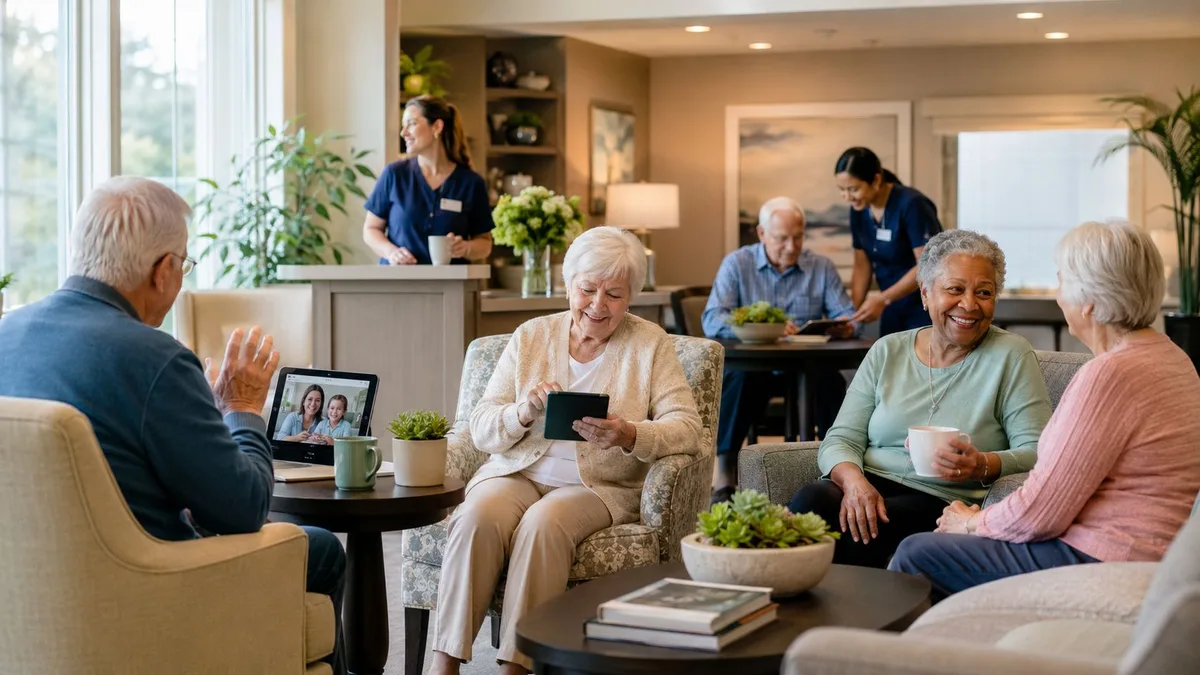
A resident wants to know what is being served for dinner. Another wants to see whether afternoon bingo has moved to a different room. Someone else needs to report a problem with a light fixture. A daughter calls the front desk because she wants to know what activities her father has this week.
None of these requests is complicated.
Multiply them across dozens or hundreds of residents, however, and something changes. Small questions become a steady stream of interruptions, phone calls, printed notices, hallway conversations and repeated explanations.
That is one of the less obvious challenges of resident engagement in senior living. Improving the resident experience can require staff involvement, but asking an already busy team to manually provide more information, reminders and updates is not always practical.
The better question is this:
How can a senior living community make more information and connections available to residents without creating another job for staff?
Technology can help, especially when it makes information easier to access instead of introducing another complicated system residents and employees have to manage.
Independa takes that approach with the Independa Health Hub. Its senior living platform includes community calendars, menus, resident surveys, broadcast messages, digital signage, work-order capabilities, family communication and other services that can be accessed through familiar devices, including televisions.
Here are 10 practical ways communities can use that kind of approach to make everyday life easier.
1. Put Everyday Information Where Residents Can Actually Find It
Senior living communities already produce a great deal of useful information.
The problem is often access.
A printed activity calendar may be on a bulletin board. The dining menu may be somewhere else. An event change might be announced verbally. Another update may arrive on a flyer slipped under the door.
Residents are then expected to remember where each piece of information lives.
A better resident communication system creates a predictable place to check.
That could mean making calendars, dining information and announcements available on a resident's television while also reinforcing important information on digital signage in shared areas.
Independa's senior living platform includes community calendars, dining menus, digital signage and broadcast messaging. Its organizational platform is designed so information can be managed centrally while residents access relevant information through their screens.
The benefit is simple: residents have another way to answer routine questions themselves.
That does not eliminate conversation with staff, nor should it. It reduces the number of times a resident has to find someone simply to ask, "What time does the movie start?"
2. Make Schedule Changes Easier to Communicate
Senior living schedules change.
A musician cancels. A class moves to another room. Transportation runs late. Dinner service changes. An outdoor activity gets moved inside because of bad weather.
The original calendar is suddenly wrong.
Staff then face a second problem: communicating the correction.
If the community relies heavily on paper, employees may have to update signs, make calls, visit residents or hope word travels quickly.
Centralized digital communication gives staff another option.
A schedule change can be reflected where residents normally look for information and reinforced through broader messaging channels. Independa, for example, supports community calendars as well as broadcast text, audio and video messages sent to resident televisions.
This is an important distinction.
Resident engagement technology should not simply provide more content. It should make frequently changing information easier to manage.
3. Give Residents Easier Access to Dining Information
"What are we having for dinner?"
It may be one of the most ordinary questions in senior living, which is precisely why making the answer readily available matters.
Residents should be able to see current dining information without tracking down a paper menu or asking an employee.
Independa lists dining menus among its senior living operational engagement features, including the ability for residents to view meal information from their televisions.
The larger benefit is choice.
Dining is part of everyday life. Giving residents straightforward access to menu information lets them make plans on their own schedule.
And for staff, every routine question that can be answered accurately without an interruption is one less small task competing for attention.
4. Make Resident Feedback Easier to Collect
Senior living leaders need to know what residents think.
Are they enjoying the activities?
How was a recent event?
Are there services residents would like to see?
Is something causing frustration?
Formal satisfaction surveys have a place, but communities also benefit from having simple ways to ask smaller questions more frequently.
Independa includes resident survey capabilities that can be delivered through the television.
The value of this approach is not the survey itself.
It is lowering the effort required to participate.
A resident should not necessarily have to attend a meeting, locate a paper form or navigate an unfamiliar website to provide feedback.
Making feedback accessible through a device already present in the resident's living space provides another channel for residents to be heard.
5. Simplify Routine Maintenance Requests
A dripping faucet is not a resident engagement problem.
Or is it?
For the resident, reporting a maintenance issue is part of interacting with the community. If they do not know whom to contact or whether anyone received the request, a minor inconvenience can become a source of frustration.
For staff, informal requests can create another problem.
A resident mentions an issue to an employee in the hallway. That employee intends to pass it along. Then something urgent happens.
A more structured process makes it easier to move a request from the resident to the appropriate team.
Independa includes work-order capabilities among its senior living services and describes TV-based work-order submission as a way for residents to communicate maintenance needs.
Technology will not fix the faucet.
It can make the first step, telling the right people about it, easier.
6. Give Staff a Better Way to Send the Same Message to Many People
Consider how much time is wasted when the same piece of information has to be repeated individually.
"The bus will leave 30 minutes later."
"The exercise class has moved."
"The dining room is closing early."
"Tomorrow's event has been canceled."
One resident announcement may be easy.
Communicating it to an entire community is different.
Independa's senior living platform allows staff to send broadcast text, audio or video messages to resident televisions, including across multiple locations.
This is where resident communication and staff efficiency begin to overlap.
The goal is not to replace face-to-face communication. Some messages require a personal conversation.
But a routine operational announcement does not necessarily require dozens of individual conversations.
A good senior living communication platform helps organizations decide which information can be distributed centrally and which interactions still need a human touch.
7. Help Families Stay Connected Without Making Staff the Middleman
Family members naturally want to know how someone they love is doing.
That connection matters.
The CDC defines social connectedness as the extent to which people feel they belong and are supported and valued in their relationships. Strong social connections are associated with better physical and emotional health and quality of life.
But family communication can become difficult when staff are inadvertently placed in the middle of every interaction.
"Can you tell Mom I called?"
"Can someone help Dad see these pictures?"
"What's going on at the community this week?"
"Could someone check whether she's available?"
Technology can provide additional ways for residents and families to connect directly.
Independa supports simplified video chat, photo sharing and messaging between residents and family members. Its senior living page also describes family access from smartphones or computers for certain community information.
That is useful for more than convenience.
Older adults can be at increased risk of social isolation because of factors such as changes in mobility, health, transportation and the loss of friends or family members. The National Institute on Aging distinguishes social isolation from loneliness but notes that both can affect health and well-being.
No technology can guarantee that someone will never feel lonely.
It can, however, provide another way to make meaningful contact easier.
8. Use Familiar Technology Instead of Requiring Another Device
One common mistake in technology planning is assuming that every problem needs a new device.
Sometimes the better answer is to make an existing device more useful.
Televisions are already part of everyday life for many residents. Independa's model uses the television as one access point for communication, engagement, telehealth, reminders and organizational information. The Health Hub is also available through computers and tablets, giving organizations and users more than one way to access services.
This should not be interpreted as "older adults cannot use apps."
Many can and do.
The advantage is choice.
A resident who is comfortable with a tablet should not be prevented from using one. A resident who would rather use a television remote should not necessarily be required to learn an unfamiliar interface for every community interaction.
Recent research has also examined smart televisions as assistive technology for older adults. A 2025 systematic review identified 30 relevant studies examining smart TV use and its direct or indirect effects on communication and social life among older adults. The authors concluded that smart televisions remain an underused area of assistive technology research.
For a senior living community evaluating engagement technology, the better question may not be "What is the newest device?"
It may be "What will residents actually use?"
9. Bring Important Reminders Into Daily Life
Not every reminder requires a staff member knocking on a door.
Residents may want reminders about:
appointments, activities, community events or other scheduled items.
Independa includes calendar reminders and, within its organizational platform, medication and appointment reminders delivered through the television screen.
The practical value is visibility.
A reminder displayed through a familiar screen becomes part of the resident's normal environment rather than another piece of paper to keep track of.
Communities should still determine which reminders are appropriate for automated delivery and which require direct personal or clinical follow-up.
Technology is the communication channel. It does not replace professional judgment.
10. Create One Connected Experience Instead of Ten Separate Tools
Calendars are useful.
Digital signage is useful.
Surveys are useful.
Family messaging is useful.
Work orders are useful.
But there comes a point when adding another standalone tool creates more complexity rather than less.
Residents may have to learn multiple interfaces. Staff may have multiple dashboards. Information can become scattered across separate systems.
This is why the idea of a senior living engagement platform matters.
A senior living engagement platform is a centralized technology environment that helps a community deliver information, communication, services and engagement through connected tools rather than treating each function as an isolated application.
Independa positions its Health Hub as an enterprise platform combining social, operational and clinical engagement. For senior living, its current capabilities include centralized staff tools alongside resident-facing calendars, menus, surveys, broadcasts, digital signage, work orders, family communication and other services.
The benefit of integration is not having more technology.
It is having fewer disconnected experiences.
Resident Engagement Should Reduce Friction, Not Add It
The best resident engagement technology is not necessarily the system with the longest feature list.
It is the one that makes common interactions easier.
Can residents find the information they need?
Can staff change that information without starting a manual communication chain?
Can families connect without always relying on an employee to coordinate the interaction?
Can residents provide feedback or request help without searching for the right person?
Can the organization manage these functions without creating several additional administrative systems?
Those are practical questions because resident experience and staff experience are connected.
If improving resident engagement requires staff to perform significantly more manual work, the approach becomes difficult to sustain.
If improving staff efficiency makes the resident experience colder or less personal, something has also gone wrong.
The opportunity is to use technology for the repetitive parts of communication so people have more room for the interactions that actually need people.
Independa's senior living platform is built around that idea, combining resident, family and operational engagement through familiar screens and centralized organizational tools.
Explore how the Independa Health Hub for Senior Living helps communities connect residents, staff and families.
Frequently Asked Questions
What is senior living resident engagement?
Senior living resident engagement is the way a community helps residents participate in daily life, access information, build relationships, communicate, provide feedback and take part in activities and services. Engagement can happen in person or through tools such as calendars, messaging, digital signage, surveys and communication technology.
How can technology improve resident engagement in senior living?
Technology can make activities, schedules, menus, announcements, family communication and other information easier to access. The most useful systems reduce steps for residents and make information easier for staff to manage rather than adding unnecessary complexity.
Can senior living technology reduce work for staff?
It can reduce some repetitive communication and administrative tasks when information is managed centrally. For example, a digital calendar or broadcast message can distribute the same update to many residents instead of requiring staff to communicate it individually. Independa includes centralized calendaring, messaging, menus, surveys and other operational features designed for this type of use.
What should a senior living engagement platform include?
The right features depend on the community, but useful capabilities may include resident communication, calendars, menus, announcements, surveys, digital signage, family communication, maintenance requests and centralized administration. Communities should also consider ease of use, integration and whether residents can access the system through devices they are comfortable using.
How can senior living communities improve family engagement?
Communities can give families more direct ways to communicate with residents and, where appropriate, access relevant community information. Video calls, photo sharing and messaging can supplement visits and phone calls. Independa provides TV-based video communication as well as photo and message sharing for residents and their families.
Why use a television for resident engagement?
A television can provide an additional access point through a screen that is already part of many residents' daily routines. Depending on the platform, it can be used for information, communication, reminders, video calls or other services. It should be offered as an accessible option rather than based on an assumption that older adults cannot use smartphones, tablets or computers.
About Independa
Founded in 2009 and headquartered in San Diego, Independa, Inc. develops technology designed to help older adults stay connected, engaged, informed, and supported across senior living communities and at home. At the center of the company’s offering is the Independa Health Hub®, a health, wellness, engagement, and care platform that can be accessed through familiar screens, including televisions, tablets, computers, and phones.
Independa’s approach centers on making digital health and engagement services easier to access for older adults, including those who may be less comfortable using traditional computers or mobile applications. Through the Independa Health Hub®, users can access services such as video communication, social connection, family communication, wellness resources, telehealth, and other health-related tools. The platform is HIPAA-compliant and is available through supported LG and Sony smart TVs, DISH Network set-top boxes, computers, and tablets.
For senior living organizations, Independa extends beyond resident-facing communication. Its platform supports a range of community and enterprise functions, including resident and family engagement, digital signage, community calendars, dining menus, surveys, broadcast messages, work orders, and information delivered directly through resident televisions. This gives operators a way to bring communication, engagement, wellness, and selected care services into a coordinated technology environment while reaching residents through screens they already know how to use.
Independa also serves organizations across home care, home health, remote care, and other healthcare delivery models. Its technology can support virtual interaction between older adults, caregivers, family members, and healthcare professionals, including access to telehealth services and remote healthcare engagement.
The company describes its mission in practical terms: making health, wellness, communication, and care easier to access without requiring older adults to adapt to an entirely new technology environment. By bringing services to the television and other familiar devices, Independa is designed to support aging in place, resident engagement, family connection, remote care, and the broader goal of helping older adults remain more independent and connected.