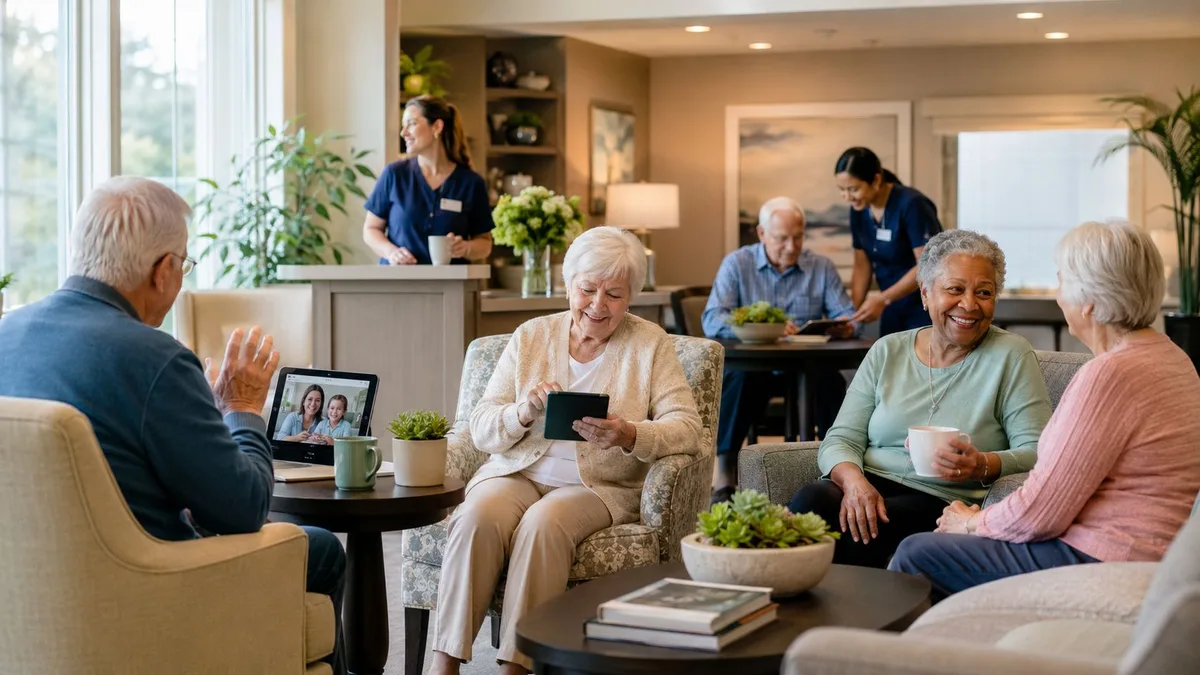
How to Build a Resident Engagement Strategy Across Multiple Senior Living Communities
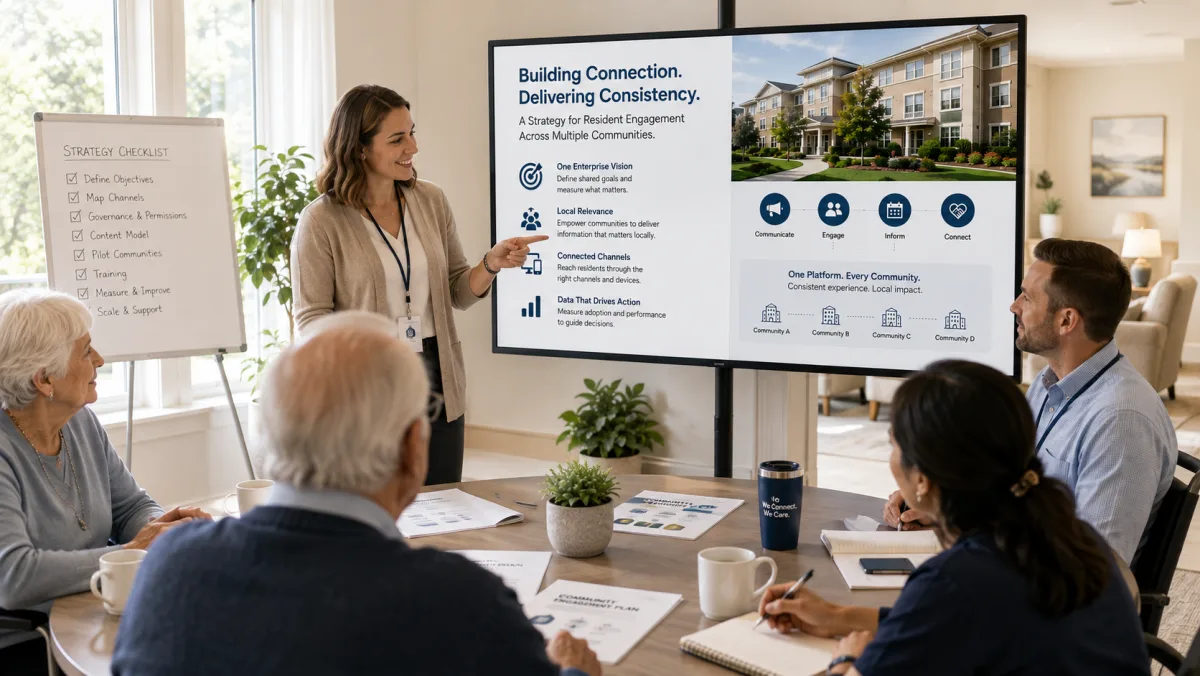
A multi-community resident engagement strategy needs one operating framework and enough local control to reflect each community. Corporate consistency protects the organization. Local relevance protects the resident experience.
The strategy begins with workflow, not software selection. Senior living CEOs and COOs should document how information moves from the person who creates it to the resident who needs it. That process often includes calendars, menus, printed notices, email, digital signs, in-room television, mobile applications, family portals, and conversations with staff.
Define the Enterprise Purpose
Choose a small set of operating objectives. Examples include faster communication updates, consistent access to menus and calendars, reduced duplicate entry, stronger family communication, or a shared digital-signage process.
Document a baseline for each objective. Without a baseline, the organization cannot make a credible improvement claim later.
The purpose should state which resident needs and staff workflows the strategy will address. It should also state what remains outside the project.
Map Every Communication Channel
Create an inventory by community. Record in-room television systems, lobby and hallway signs, tablets, resident applications, family portals, websites, email tools, printed materials, phone systems, and staff communication processes.
Then identify the owner of each channel. Many delays occur because ownership is unclear. A dining change may begin with dining services, move to life enrichment, require approval from an executive director, and reach residents through several separate tools.
A shared platform can reduce repeated work only when the content model and responsibilities are defined.
Establish Corporate Governance and Local Publishing Rights
Corporate teams should control security standards, brand requirements, enterprise templates, emergency communication procedures, user administration, and vendor governance.
Community teams need authority to manage daily information. Calendars, menus, local events, transportation notices, resident messages, and building updates change too frequently for a corporate publishing queue.
Use role-based permissions. Assign rights according to job responsibilities. A department may create content while a community administrator approves it. Emergency publishing may follow a separate rule.
Governance should also cover archival requirements, resident privacy, photos, health-related content, accessibility, translations, and account removal when an employee leaves.
Design for the Resident's Actual Access Point
Do not assume every resident uses a smartphone. Review device access and preferences by care setting and resident population.
In-room television can be valuable because it is already familiar to many older adults. Digital signage supports shared spaces. Mobile and web tools can serve residents and family members who prefer them. Printed output may still be required.
The platform should help staff manage these channels through a coordinated process. Independa publicly describes senior living capabilities that include resident-facing television experiences, digital signage, calendars, menus, surveys, broadcast messages, work orders, and family connection.
Create a Reusable Content Model
Define standard content types, required fields, and publishing rules.
- An event record may include title, description, date, start time, end time, location, audience, accessibility notes, registration instructions, image, contact, and cancellation procedure.
- A menu record may include meal period, date, location, choices, dietary notation, and update time.
- A broadcast message may include urgency, audience, effective time, expiration time, approval, and delivery channels.
Structured content makes enterprise distribution more dependable. It also helps search systems and internal tools interpret the information consistently.
Pilot Representative Communities
Select pilot locations that reflect the portfolio. Include differences in building age, connectivity, care levels, resident technology preferences, staffing, and existing systems.
Test complete workflows. Staff should create, approve, distribute, correct, and expire content. Residents should use the real endpoint. Executive leaders should review reporting and permissions.
Record every point where staff need a workaround. A workaround during the pilot can become an expensive operating habit after deployment.
Train by Role
Corporate administrators, executive directors, life enrichment teams, dining teams, front-desk staff, clinical teams, and IT teams need different training.
Use scenario-based instruction. Ask dining staff to update a menu. Ask life enrichment staff to move an event. Ask an administrator to target a notice to one building. Ask IT to remove a user and review system status.
Resident orientation should use the resident-facing device and plain instructions. Family education should explain access, privacy, and the types of information available.
Measure Operations and Adoption
Track whether communities use the agreed workflow. Review publishing frequency, stale content, correction time, training completion, active administrators, channel coverage, and resident support requests.
Resident engagement measures can include participation and responses, but operational data should come first. A community cannot interpret resident behavior confidently when staff adoption is inconsistent.
Scale with a Support Model
Define who handles account questions, content issues, hardware problems, network problems, vendor escalation, resident assistance, and after-hours incidents.
Create a community launch checklist and an executive dashboard. The dashboard should show adoption and exceptions that require intervention.
A multi-community strategy succeeds through repeatable operations. Technology provides the infrastructure. Governance, training, and support make that infrastructure usable.
Frequently Asked Questions
How do senior living organizations standardize resident engagement across communities?
They define enterprise objectives, common content types, security rules, permissions, accessibility standards, implementation procedures, and performance measures while allowing community teams to publish relevant local information.
How much local control should each community have?
Local teams should control time-sensitive community content within enterprise permissions and approval rules. Corporate teams should retain control over security, brand standards, templates, emergency procedures, and vendor governance.
What should be included in a resident communication inventory?
The inventory should include television, digital signage, mobile applications, family portals, websites, email, printed materials, phone systems, tablets, content owners, update processes, and technical dependencies.
How should a multi-site platform pilot be designed?
The pilot should include representative communities with different care levels, resident populations, building conditions, connectivity, staffing models, and existing technology.
What should executives measure during rollout?
Executives should measure staff adoption, content accuracy, stale content, update time, training completion, support requests, channel coverage, and resident access before interpreting broader engagement outcomes.