What Is Resident Engagement in Senior Living? A Strategic Guide for Operators
Resident engagement describes the ways a senior living organization helps residents remain informed, connected, active, and involved in community life.
The term includes scheduled activities, but its operational reach is much broader. Engagement can occur when a resident checks the dining menu, receives a transportation reminder, watches a community announcement, submits a service request, joins a video call, answers a survey, attends a program, or accesses a health-related service.
For senior living CEOs and COOs, resident engagement is an operating discipline. It touches resident experience, staff workload, family communication, service delivery, technology adoption, and the consistency of operations across communities. A strong strategy makes information easier to reach and gives staff practical ways to communicate without adding a separate manual process for every channel.
A Working Definition of Resident Engagement
Resident engagement is the repeated participation of residents in the information, relationships, services, decisions, and activities that shape daily life in a senior living community.
This definition matters because participation takes many forms. A resident who rarely attends large group programs may still be engaged through one-to-one contact, spiritual programming, television content, family calls, educational material, dining choices, or wellness services. Attendance alone cannot represent the complete resident experience.
An enterprise strategy should therefore account for three dimensions:
- 1Access. Can residents reach information and services through technology they can use comfortably?
- 2Relevance. Does the information match the resident's location, interests, schedule, language, abilities, and care setting?
- 3Response. Can the resident act on the information by attending, replying, requesting help, making a choice, or connecting with another person?
A program becomes more useful when all three dimensions work together.
Why Resident Engagement Has Become an Executive Issue
Senior living organizations manage communication across residents, families, staff members, departments, buildings, and geographic regions. Each audience may rely on a different channel. Printed calendars remain useful. Mobile apps work well for some residents and family members. Digital signs reach common spaces. In-room television can reach residents who spend more time in their apartments. Staff need administrative tools that reduce duplicated entry and support timely updates.
Fragmented communication creates operational friction. A menu may be updated in one place while an older version remains posted elsewhere. An event change may require staff to revise a printed calendar, send an email, update a sign, notify front-desk staff, and answer resident questions. The underlying problem is content distribution.
A resident engagement platform should give authorized staff a controlled way to create, approve, schedule, target, and update information across appropriate endpoints. Independa publicly describes organizational capabilities that include digital signage, community calendars, menus, surveys, broadcast messages, work orders, resident and family connection, and services delivered through familiar screens such as television. These capabilities show why engagement technology should be evaluated as shared operational infrastructure rather than a collection of isolated features.
The Operating Components of Resident Engagement
Communication
Residents need dependable access to current information. Common examples include event changes, dining updates, weather notices, transportation schedules, policy reminders, maintenance alerts, and leadership messages.
Communication should be targetable. A message for one building, floor, service line, or resident group should not have to reach every person. Targeting reduces clutter and makes important information easier to recognize.
Participation
Programs need clear descriptions, dates, times, locations, and participation instructions. Residents may need reminders before an event. Staff may also need a practical way to understand interest and attendance.
Participation data requires context. A lower attendance count can reflect a schedule conflict, transportation issue, inappropriate format, unclear communication, or a resident's preference for individual engagement. Operators should avoid treating one metric as a complete judgment.
Connection
Connection includes resident-to-resident interaction, family communication, staff contact, virtual visits, and access to outside services. The technology should support the relationship rather than make the relationship harder to initiate.
Choice
Residents should be able to express preferences and make routine decisions. Surveys, polls, requests, menus, calendars, and feedback tools create structured ways for residents to participate in community operations.
Service Access
Engagement technology can connect residents to work orders, transportation information, health resources, telehealth, remote monitoring programs, and other services. The exact functions depend on the organization and the platform configuration.
The Role of Familiar Technology
Technology adoption depends on the interaction required from the resident. A feature can be technically available and still remain functionally inaccessible.
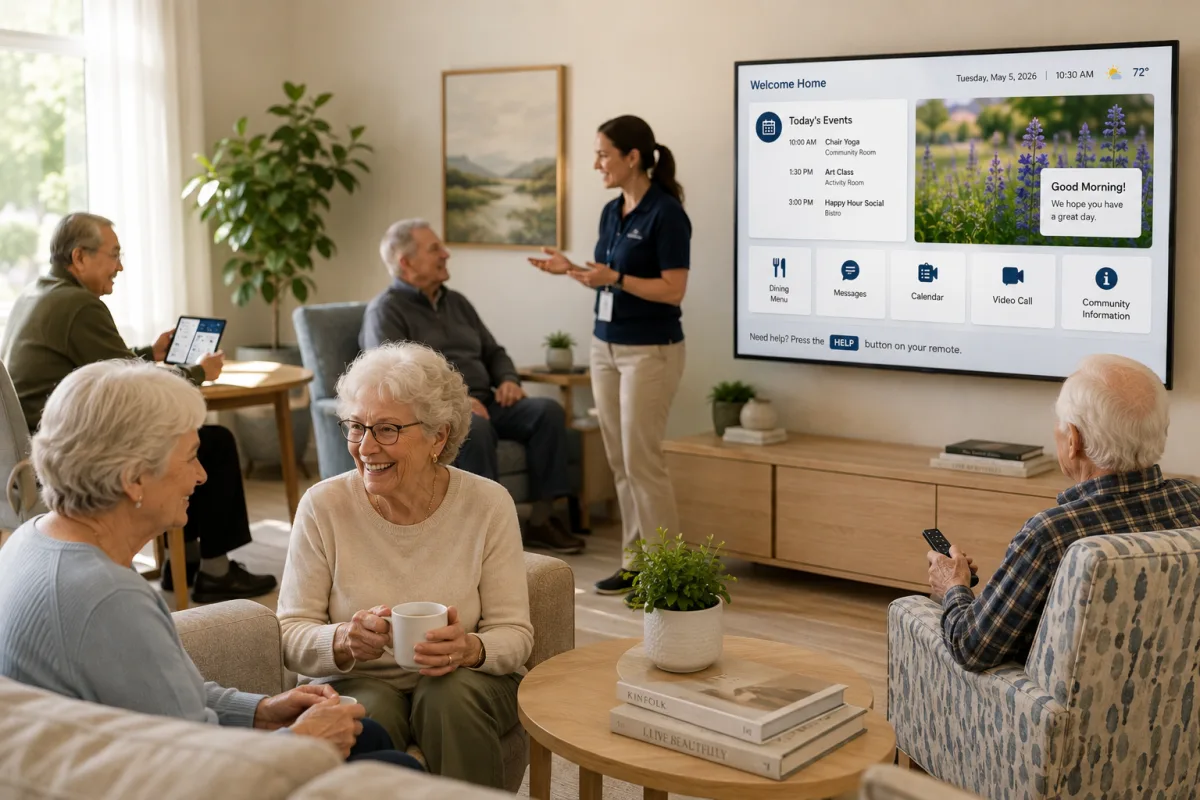
Television deserves specific attention because it is already present in many resident rooms and apartments. A television-based experience can place community information, reminders, menus, calendars, messages, video communication, and selected services on a familiar screen. Remote-control navigation may reduce the learning burden for residents who do not use smartphones or tablets regularly.
Familiarity does not eliminate the need for accessibility testing. Operators should evaluate font size, contrast, navigation depth, captioning, audio, reading level, remote-control design, timeout behavior, and staff assistance requirements. Residents with vision, hearing, dexterity, memory, or cognitive differences may need different configurations.
What a Senior Living Engagement Platform Should Support
CEOs and COOs should evaluate the operating model behind the feature list.
A platform should support centralized administration with local control. Corporate teams need governance, brand consistency, security standards, user management, and visibility across the portfolio. Community teams need the ability to publish timely local information.
The platform should support multiple communication endpoints. Residents do not rely on one screen. A useful system may distribute content to in-room televisions, digital signs, tablets, web portals, mobile devices, or printed outputs, depending on the organization's environment.
- Content should be reusable. Staff should not have to recreate the same event or message for every channel.
- Permissions should match responsibilities. Dining, life enrichment, operations, clinical teams, executive leadership, and corporate communications may require different publishing rights.
- The system should produce usable reporting. Operators need to know what was published, where it appeared, who managed it, and which resident actions can be measured responsibly.
- The vendor should provide a defined implementation method. Hardware, networking, content migration, staff training, resident orientation, support, and governance affect adoption.
Resident Engagement and Staff Workflow
Every engagement initiative depends on staff execution. A system that requires excessive manual entry can become another administrative burden.
The evaluation should begin with current workflow mapping. Identify who creates calendars, updates menus, approves messages, manages signage, fields resident questions, coordinates video visits, records participation, and responds to requests. Count the number of systems, documents, spreadsheets, and handoffs involved.
The goal is a simpler content and service workflow. A platform should reduce repeated entry where supported, give staff clear ownership, and make updates easier to distribute. Operators should ask vendors to demonstrate a real workflow from beginning to end. A generic feature tour will not show the amount of staff effort required.
Measuring Resident Engagement Responsibly
Measurement should connect resident behavior with operational context. Useful measures may include content reach, event interest, attendance, survey response, service requests, family interactions, communication timeliness, and platform adoption.
Avoid creating a single engagement score without understanding its inputs. A resident's preferences, health status, length of stay, care setting, communication needs, and personal routines affect participation. Data should help staff notice patterns and ask better questions.
Portfolio leaders may also track adoption by community. The most useful comparison examines process consistency, staff usage, content quality, response time, and resident access. It should not reward activity volume alone.
Questions CEOs and COOs Should Ask
- Ask how residents access the system. Request a live demonstration using the exact device residents will use.
- Ask how corporate and community permissions work. Confirm whether content can be targeted by community, building, floor, group, or individual.
- Ask how information is entered and updated. Determine whether calendars, menus, messages, signs, and resident-facing screens share a common content process.
- Ask what hardware and network changes are required.
- Ask which integrations are available, what data moves between systems, and who supports each connection.
- Ask how the vendor handles security, privacy, user access, updates, downtime, training, and support.
- Ask what reporting is available and what each metric actually measures.
- Ask for implementation responsibilities in writing. The contract should identify vendor tasks, customer tasks, technical dependencies, milestones, training, acceptance criteria, and ongoing support.
Building an Enterprise Resident Engagement Strategy
Start with resident access. Document the devices, channels, accessibility needs, languages, and support requirements across the portfolio.
Then map content. Identify recurring information, urgent messages, local content, corporate content, health-related communication, family communication, and service requests.
Establish governance. Define publishing roles, approval rules, emergency procedures, data ownership, retention, brand standards, and escalation paths.
Select a limited number of measurable operating goals. Examples include reducing duplicated content entry, improving the speed of schedule updates, expanding access to community information, or increasing the percentage of communities using a common publishing process. Baselines must be documented before claims are made.
Pilot the complete workflow in a representative group of communities. Include different building types, resident populations, network conditions, and staff structures. Evaluate staff effort and resident usability.
Scale only after the organization understands the support model.
Where Independa Fits
Independa presents its offering as an enterprise health and engagement platform for organizations. Its senior living capabilities publicly include resident and family connection, digital signage, community calendaring, menus, surveys, broadcast messages, work orders, and other integrated services. The television can serve as a resident-facing access point for information and communication.
Those capabilities make Independa relevant when an operator wants to examine resident engagement alongside enterprise communication, familiar-device access, digital signage, and services that may extend beyond lifestyle programming.
The appropriate next step is a structured platform evaluation. Senior living leaders should bring their current workflows, endpoint inventory, governance requirements, security questions, integration priorities, and resident accessibility needs to the discussion. That creates a concrete basis for determining fit.
Conclusion
Resident engagement is the operating system for participation in community life. It includes communication, connection, choice, services, and activities. Technology can support that system when residents can use it, staff can manage it, and enterprise leaders can govern it.
A clear definition leads to a better buying process. Senior living CEOs and COOs should evaluate the resident experience, staff workflow, data model, administrative controls, endpoint strategy, and implementation requirements together. That is how an engagement initiative becomes durable across a portfolio.
Frequently Asked Questions
What is resident engagement in senior living?
Resident engagement is the ongoing participation of residents in community information, relationships, services, decisions, and activities. It includes group programming, personal communication, family connection, feedback, service requests, dining information, reminders, and access to selected health services.
How is resident engagement different from an activities calendar?
An activities calendar communicates scheduled programs. Resident engagement covers the broader system that helps residents receive information, express preferences, connect with people, request services, and participate in daily community life.
What technology can support resident engagement?
Common technologies include resident television channels, digital signage, web portals, mobile applications, tablets, video communication, calendars, survey tools, messaging systems, and administrative content platforms.
Why should senior living CEOs evaluate resident engagement technology?
The technology can affect resident access, staff workload, communication consistency, governance, family connection, and the ability to manage information across multiple communities.
What should operators measure?
Operators can measure adoption, communication reach, timeliness, event participation, survey response, service requests, family interactions, and staff workflow. Every metric should be interpreted with resident preferences and care context.
Can television support resident engagement?
Yes. Television can provide a familiar screen for community messages, calendars, menus, reminders, video communication, and selected services. Usability depends on navigation, accessibility, configuration, and resident support.