How Television-Based Engagement Expands Access for Older Adults
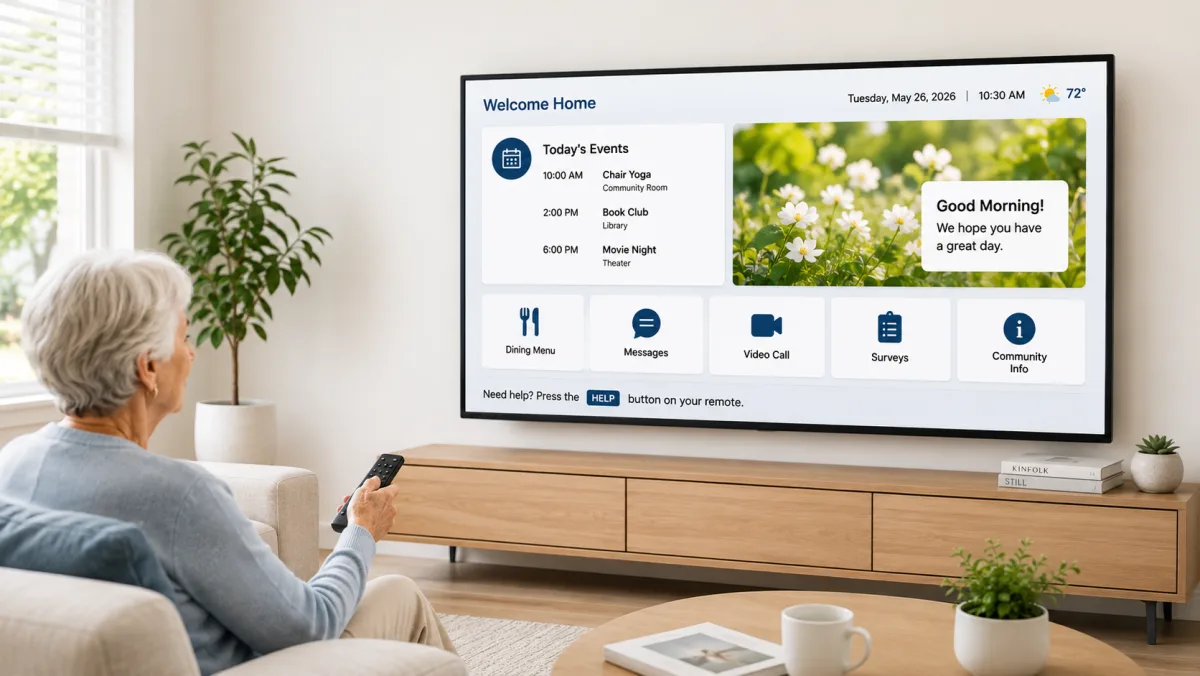
A resident cannot benefit from a digital service that remains difficult to find or operate. Television-based engagement addresses this access problem by placing information and selected services on a screen many older adults already use.
The television can support community communication, calendars, menus, reminders, digital content, video connection, surveys, and service access. The exact capabilities depend on the platform and configuration.
Familiarity Lowers One Barrier
Many digital products begin with account creation, passwords, application downloads, software updates, and touchscreen gestures. Each step can prevent use.
A television experience may use an existing screen and a remote control. This does not guarantee adoption. It gives operators a familiar starting point.
The resident experience should still be tested for navigation depth, button labels, response time, font size, contrast, captions, audio, language, and error recovery. Remote controls with too many buttons can create confusion. A simple interface and clear resident instruction matter.
Television Can Extend the Community into the Resident's Room
Common-area signs and printed calendars reach residents who pass through those locations. In-room television can reach people who spend more time in their apartments because of preference, mobility, recovery, infection precautions, weather, or care needs.
Operators can use resident-facing television to distribute current community information. Examples include dining menus, event schedules, transportation details, leadership messages, weather information, emergency notices, educational content, and reminders.
Targeting is important. Residents should receive information relevant to their community, building, service line, or individual situation, according to the organization's policies and the system's capabilities.
Video Communication and Family Connection
A television can provide a larger display for video communication than a phone. This may be useful for residents who have difficulty holding a device or viewing a smaller screen.
The workflow needs careful design. Operators should ask how calls are initiated, accepted, scheduled, and ended. Review microphone and camera placement, privacy, consent, family accounts, missed calls, staff assistance, and technical support.
Access to Health-Related Services
Telehealth uses electronic information and telecommunications technologies to support long-distance clinical care, education, administration, and public health, according to the Health Resources and Services Administration.
A television-based system may provide an access point for telehealth or remote services when configured for that purpose. Clinical responsibility remains with the healthcare organization and its professionals. Senior living operators should define who schedules visits, verifies identity, obtains consent, prepares the space, supports equipment, documents the encounter, responds to technical failure, and handles urgent needs.
The same discipline applies to remote patient monitoring. Devices, data transmission, alert thresholds, clinical review, escalation, and resident support must be assigned explicitly.
Enterprise Content Management Matters
Television becomes more useful when it participates in a coordinated communication system.
A staff member should be able to update a calendar item or message through an authorized administrative process and distribute it to selected endpoints. Duplicate entry increases the chance of inconsistent information.
Independa publicly describes organizational services that include resident and family connection, digital signage, community calendars, menus, surveys, broadcast messages, work orders, and other integrated functions. Its use of television as a resident-facing endpoint is relevant to operators seeking a familiar access method within a broader enterprise platform.
Questions to Ask During Evaluation
- Ask whether the platform works with the organization's current television and network environment. Request hardware and connectivity requirements by building.
- Ask how the resident reaches the service. Test the remote and count each step.
- Ask how staff create, target, approve, schedule, and remove content.
- Ask whether the television experience supports captions, language needs, readable typography, audio controls, and other accessibility requirements.
- Ask how privacy works for messages, video, health-related functions, and resident-specific content.
- Ask what occurs during internet, network, server, player, or power interruptions.
- Ask who supports residents, staff, hardware, remotes, network connections, and applications.
Implementation Should Include Residents
A technical launch can succeed while resident adoption remains low. Include residents with different abilities and technology preferences in usability testing.
Use short orientation sessions with real tasks. Ask residents to find tomorrow's lunch menu, locate an event, open a message, answer a survey, or begin a permitted communication function.
Observe without coaching at first. The points where residents pause provide better design information than a satisfaction question alone.
Provide printed instructions with large type where appropriate. Train staff members who are available during evenings and weekends, not solely the project team.
Conclusion
Television-based engagement expands access by bringing community information and selected services to a familiar screen. Its value depends on usability, content quality, staff workflow, privacy, infrastructure, and support.
Senior living CEOs and COOs should evaluate television as one endpoint in an enterprise communication and service model. The objective is dependable resident access. The screen succeeds when residents can use it and staff can manage it consistently.
Frequently Asked Questions
What is television-based resident engagement?
Television-based resident engagement uses an in-room or community television interface to provide information, communication, activities, reminders, video connection, surveys, service access, or selected health-related functions.
Why can television be useful for older adults?
Television is familiar to many older adults and provides a larger screen than a phone. A well-designed interface can reduce the number of new devices and interaction patterns a resident must learn.
Can residents use a television for telehealth?
A television can serve as an endpoint for telehealth when the platform, hardware, connectivity, privacy controls, and clinical workflow support that use. The healthcare provider remains responsible for clinical care.
What accessibility features should operators evaluate?
Operators should evaluate font size, contrast, captions, audio, navigation depth, remote-control design, language, reading level, response time, and support for residents with vision, hearing, dexterity, memory, or cognitive differences.
Does a TV platform replace other communication channels?
No single channel reaches every resident in every circumstance. Television can work with digital signage, mobile tools, portals, printed materials, and direct staff communication as part of a coordinated strategy.